Unexpected Audiences at the Intersection of
Public Archaeology and Academic Museums
by Dana L.
My name is Dana Lewis, and I’m a graduate student in the Cultural Heritage and Resource Management Program at Southern Illinois University Edwardsville (SIUE) also working toward a Museum Studies certificate. My program is situated within the larger umbrella of Integrative Studies, and my personal track within the program has been focused on combining anthropology and historical studies to gain skills toward a future career in museum collection management and registration. Taking this public archaeology class has allowed me to build on my undergraduate specialization in archaeology and eke out a tiny niche of specialty within the sea of generalization that is museum registration and collections work. For this class’ final project, the stars aligned in a way they only can with an interdisciplinary program like this, and I was able to use my position as a graduate research assistant at SIUE’s University Museum as an “in” to a fascinating archaeological collection and hone my public archaeology communication skills at the same time!
As an experienced Twitter user, I came into this public archaeology project with a lot of expectations. My initial plan was to use the SIUE University Museum Twitter account to give old followers and new a peek behind the curtain of day-to-day operations of the museum, focusing on the archaeological material in our collections. Though SIUE students might be familiar with some of our artwork or artifacts spread throughout 40 buildings, many don’t know the scope of our collections, or that we have a facility on campus for storing and caring for them. I designed my project with three primary target audiences in mind that I wanted to reach, optimistic that the magic of the social internet would help me reach them: SIUE students, SIUE faculty, and the general archaeology and history-minded publics of the greater metropolitan area. Because this project wasn’t just to benefit the audiences but also the University Museum, I first had to meet up with my supervisor, Erin Vigneau-Dimick, to develop a social media strategy.
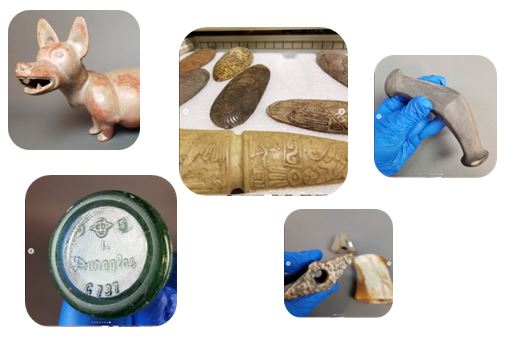
After meeting with Erin, I discovered that the University Museum had not one but three social media accounts, and that I could create posts on one platform (Twitter) to duplicate and post on the other two (Facebook and Instagram). Because of my schedule at the museum, I opted to post twice a week beginning in October for a period of about two months. The first post of the week focused on a variety of topics, from defining tricky terms and jargon that fill the archaeologist’s vocabulary to delving into why documentation and provenance matter. I also included some of the tasks I work on during my days at the museum like marking objects with their unique identification number (object ID) and creating safe and stable storage mounts for them after they’ve been cataloged. For the second post of each week, I created a fun series called “ARTIFACT OF THE WEEK” (in all caps because it’s SO EXCITING) where I highlighted a different type of archaeological artifact in our collections and gave a bit of contextual information on what they were used for and why they mattered to the culture that made and used them. Some of the artifacts featured include bannerstones, historic bottles, and a Twitter favorite, Colima dogs! Below is an example of one of these posts on Twitter.
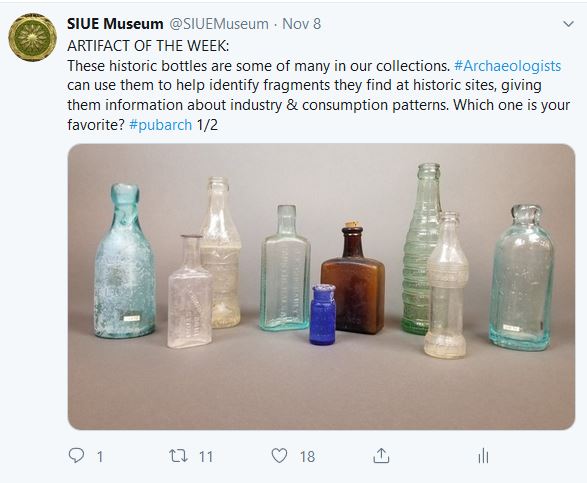
During the beginning phases of this project, I was reading a lot about the successes and failures of social media outreach at other museums. Not only is the content of the message important, but size, organization, and voice of the message matters too. As a student and not the typical administrator for the University Museum social media accounts, I wanted to make it very clear who I was and why I was posting, especially considering that these accounts were for the most part inactive prior to my “take-over.” To begin, I introduced myself with a selfie post (screenshot from Instagram this time). Here I am cheesin’ for the camera and posing with an obsidian blade and a measuring tape. Check out those gloves!
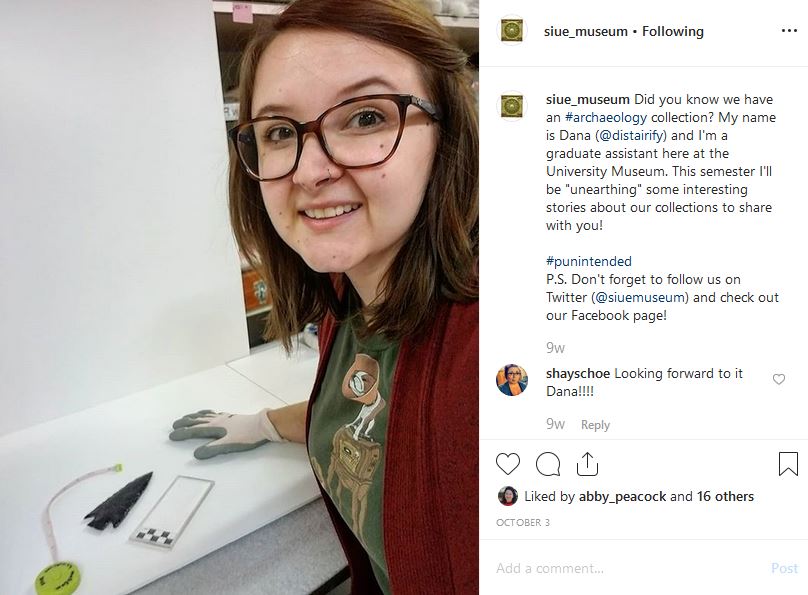
Some of the topics I wanted to cover were a little more complex, touching on ethical issues and complicated procedures. Here, the medium of the social internet presented a bit of a challenge – I needed to ease people in while at the same time being able to condense all my messages down to a very small blip of information. Inconceivable! To tackle this problem, I decided to take a narrative approach and work from the perspective of a non-expert. My first few posts were shorter, limited to one tweet or around 280 characters including hashtags, and one or two photos. After introducing myself, I explained an aspect of the first post – the gloves I was wearing – in the second, using my posts like building blocks. I reused artifacts throughout the next few posts, focusing on characteristically “archaeological” artifacts like arrowheads and other stone tools, gradually preparing my audience for something new and more complex. I think this narrative strategy worked out pretty well since I had already existing audiences on all three of the platforms that may have begun following the account for different reasons.
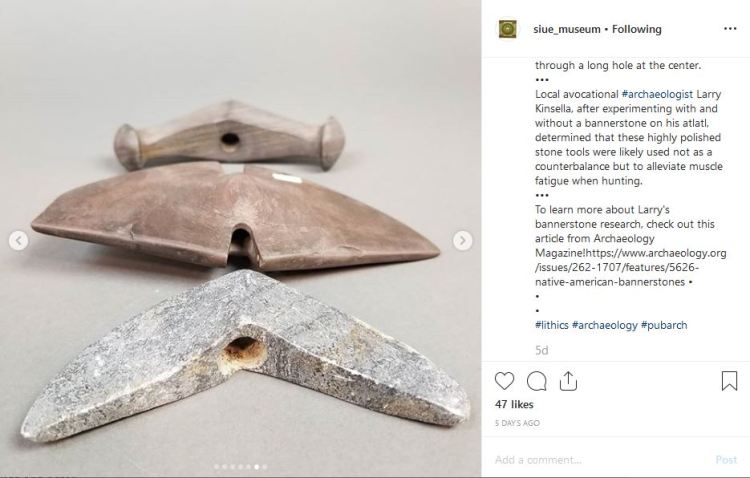
Overall, the most surprising part of this project was the audiences I wrote for. To begin with, each social media platform I used had a different audience of “followers,” driven in part by the initial posts on each platform but also the typical users of each. The University Museum’s Instagram account, for example, was started to publicize in real time the de-installation of a large sculptural artwork in the student center, as well as connect to the students and faculty of the art department. Thus, many of the followers on Instagram were artists and likely interested in the artistry, construction techniques, and visual impact of the artifacts. The most popular posts on Instagram were those featuring artifacts with interesting forms like last the ARTIFACT OF THE WEEK post, a screenshot of which is shown below.
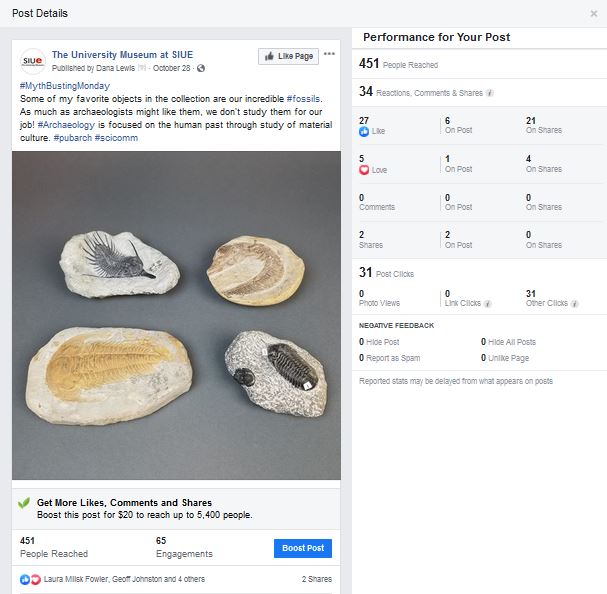
Some of the posts I expected to get a lot of attention (likes, shares, etc), such as those featuring storage mount making and the feature on historic bottles, did less well than others which I considered less interesting. My #MythbusterMonday post where I shared a photograph of some fossils while pointing out that archaeologists are interested only in the study of human material culture was actually the most popular post on Facebook (see screenshot below). Together with the varied audiences between platforms, I learned that not only did my audience have different tastes and interests than me, but my “audience” was not a monolith at all. Instead, it was comprised of many different smaller groups that, also surprisingly, didn’t totally meet my original target audiences. On Twitter, many of my posts were liked and shared by other academic museums, archaeology departments, laboratories, and archaeologists, a defined community that was likely looking to learn from another academic museum’s social media approach rather than about the artifacts themselves. Many Facebook posts were liked by community members in the Edwardsville, Illinois area where the University is located, though overall Facebook had the lowest number of “impressions” (number of times a person has seen a post whether or not they interacted with it).
To reflect and summarize, this project was a fantastic learning opportunity for me as a soon-to-be young professional in the museum field. Especially at smaller museums where there are fewer positions and thus more hats to be worn by each employee, knowing how to run a social media account (or three) is a great skill to have under my belt. Being able to experiment with this project and try to reach a few different target audiences was also a great experience. At the end, through a total of 17 original posts, I was able to grow the following of each of the University Museum social media accounts and on Twitter had a total of over 22,000 “impressions” from all posts. I’m excited to see where the University Museum social media goes next, since there’s still plenty of opportunity for exploration and future projects (graduate or undergraduate) using the collections not just for archaeology but history, art, and museum studies as well. As for me, I’m looking forward to using just my own social media accounts for a while – those cat pictures won’t post themselves!
Thanks for reading to the end of this post! This project would not have happened without support from Dr. Susan Kooiman, public archaeology professor extraordinaire; Erin Vigneau-Dimick, Executive Curator of the University Museum; and Dr. Laura Fowler, Director of the Museum Studies Program and manager of the program’s social media pages. Dr. Fowler was great enough to share almost all of my posts on Twitter and Facebook which certainly added to the success of this project.
Finally, please check out the SIUE University Museum’s social media accounts for yourself! Give them a follow or a like to see what the museum will be up to next and hopefully learn something new about our collections.
Facebook: The University Museum at SIUE
Twitter: @siuemuseum
Instagram: @siue_museum
 SIUE Public Archaeology
I loved seeing all the updates on Insta!! You did a phenomenal job.
LikeLike