by Emily L.
Introduction
Scouting presents a great opportunity for archaeologists to plan and implement outreach events for youth. Already, the Boy Scouts of Greater St. Louis (BSGSL) extend to its members many archaeological-themed events and programs. Girl Scouts of Southern Illinois (GSOFI), however, lacks sufficient opportunities for its members to engage in archaeology. Unlike BSGSL, it does not promote its archaeology badge at badge earning events, partner with local archaeology organizations, nor offer any archaeology themed programming. These inadequacies are further illustrated when comparing archaeology badges; while the Boy Scouts of America offer, at the national level, an Archaeology Merit Badge which requires learning about the craft of archaeology, hands-on archaeological experience, and career research, GSOFI has a council-level archaeology badge that requires minimal effort to earn and does not incorporate legitimate hands-n experiences or career applications, nor facilitate an adequate understanding about the discipline itself. This project involves both the creation of a specific outreach event for both the Boy Scouts of Greater St. Louis and the Girl Scouts of Southern Illinois, as well as the broader goal of improving overall archaeological curriculum offerings within the Girl Scouts of Southern Illinois’ program.
Background
As a lifelong Girl Scout, I knew that I wanted my project to allow me to work with and give back to the Scouting community. Last year, I became involved with BSGSL’s STEM University as the Archaeology merit badge instructor. This responsibility involved creating and implementing a day-long curriculum that aligned with the merit badge’s requirements. As I had volunteered again to teach at this year’s STEM University, I decided to incorporate this outreach event as part of my project. This time, equipped with a better knowledge of public archaeology, I decided to incorporate pre- and post- event evaluations to help understand how successfully my program disseminated information. Evaluation is of the utmost importance in public archaeology; Ellenberger and Richardson (2018) state that the “only way to know if archaeological outreach and community engagement are working is to ask stakeholders” (65) and argue that this understanding of our outreach work leads to better programs in the future.
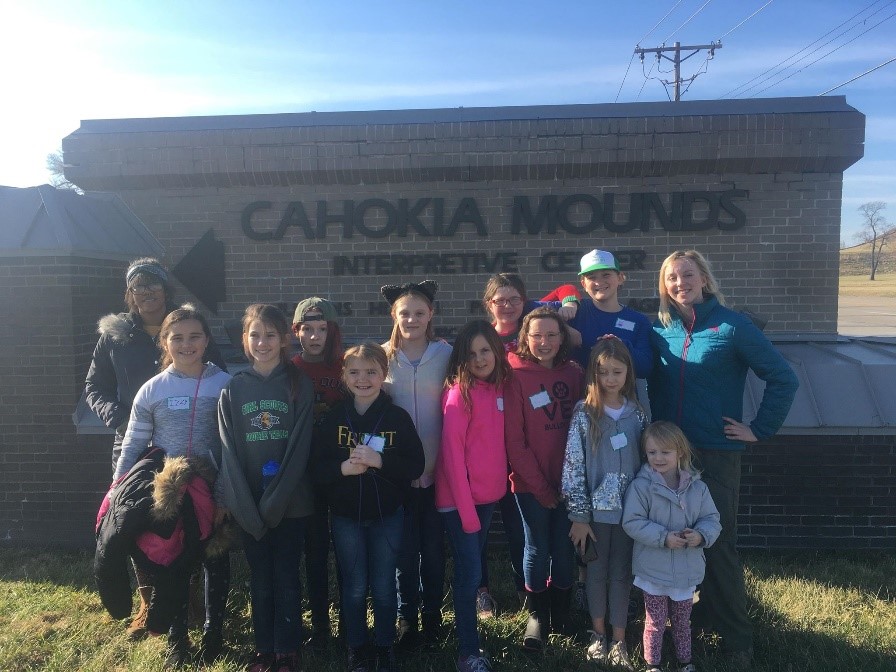
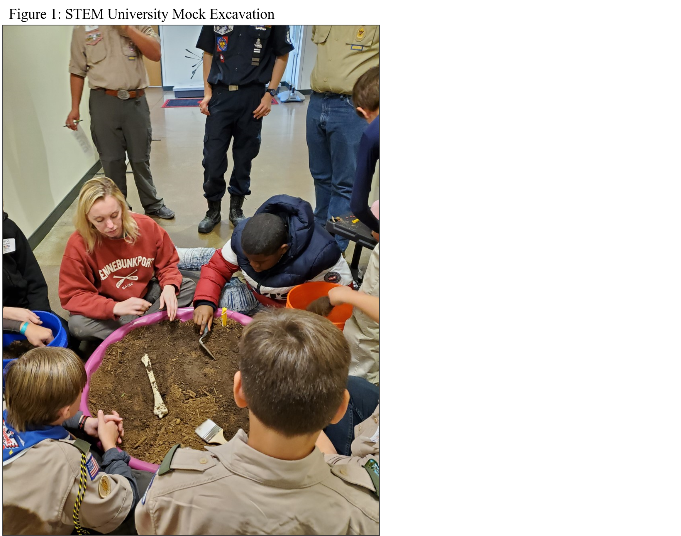
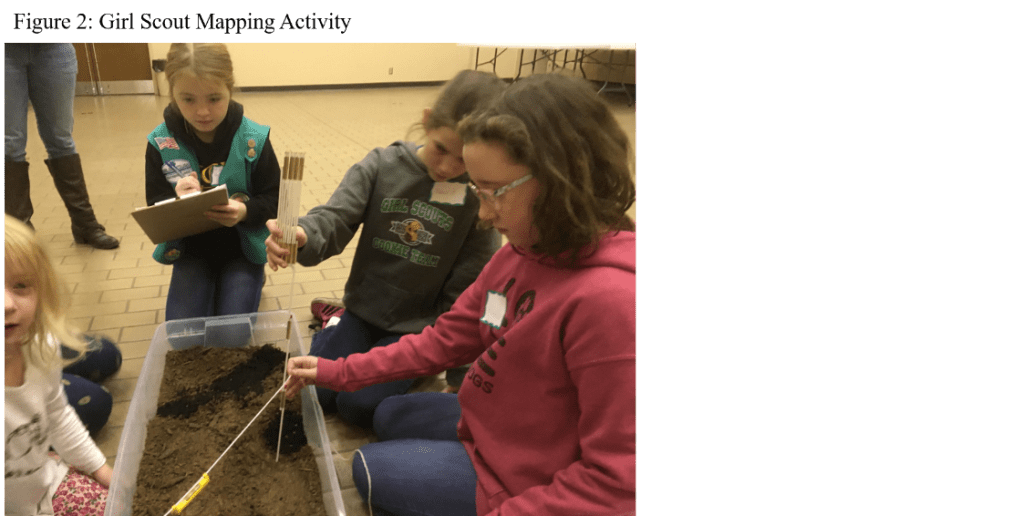
I also decided to partner with GSOFI to offer a similarly structured small-group archaeology day at our local archaeology site, Cahokia Mounds. Both programs intertwined a variety of hands-on activities and group discussion problems with instructional lecture. Henson (2017) stresses the importance of recognizing the assortment of students and their interests and learning styles, and appealing to this diversity by offering a wide variety of activities. The Florida Public Archaeology Network (2008) provides an extremely helpful guide containing activities that allow educators to do just that. It was also my goal to offer simulated practical archaeological experience at both events. At STEM University, this took the form of a small scale mock excavation (Figure 1). With the Girl Scouts, various constraints inhibited a mock excavation, but I was still able to bring in a small mock ‘site’ and practice feature mapping and soil descriptions (Figure 2). Chrislom et al. (2007) illustrates the importance of mock excavations and similar practical experiences in their article, stating that such activities involve and engage participants with the artifacts and site features, facilitates interpretation of artifact context, and, perhaps most importantly, allows participants to more thoroughly understand the practice of archaeology.
Finally, the one of the future goals of this project includes designing a more adequate local archaeology badge for older-aged Girl Scouts. Stewart et al. (2017) and Bevill (2003) provide invaluable information for this process. Stewart et al. (2017) lists considerations when designing a badge, including a) properly differentiating the badge’s purpose and requirements from pre-existing badges, b) demonstrating to potential badge earners how the badge can be used to fulfil other, larger requirements within the Girl Scout award system and c) including a comprehensive guide with resources, instead of just listing requirements. Bevill (2003) echoes these sentiments, and also emphasizes the success of such badge and patch programs in career recruitment.
Summarized, the goals of this project are to a) provide archaeology events for the local Scouting communities, b) mitigate the deficiency in archaeology programming between BSGSL and GSOFI, and c) adequately evaluate my programs.
Methods
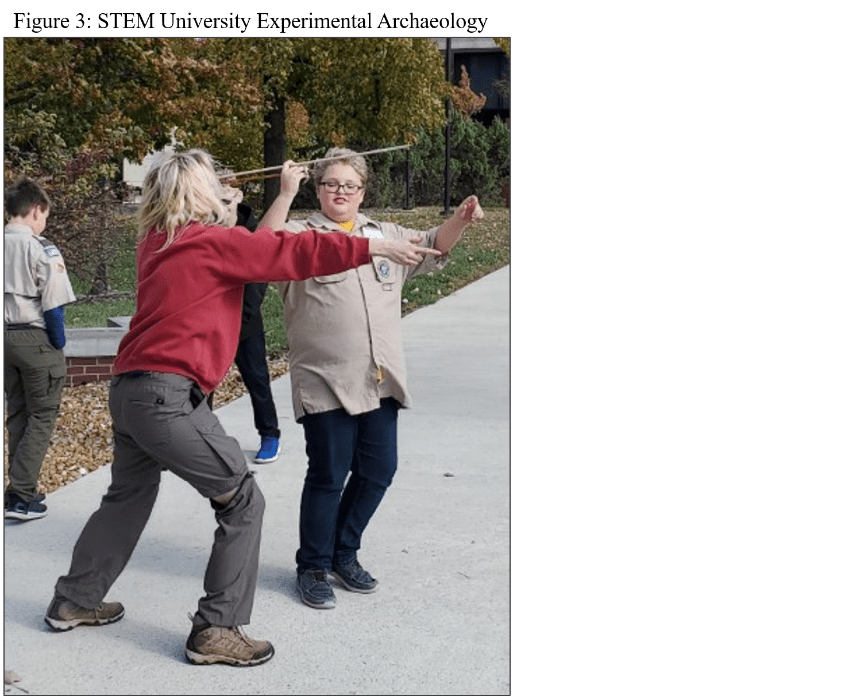
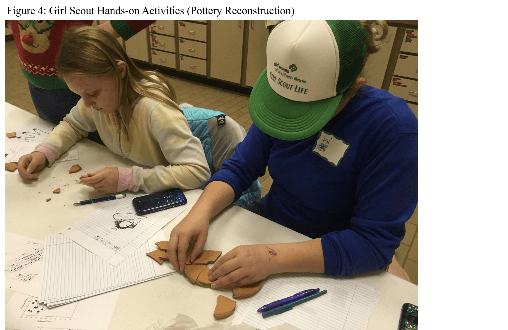
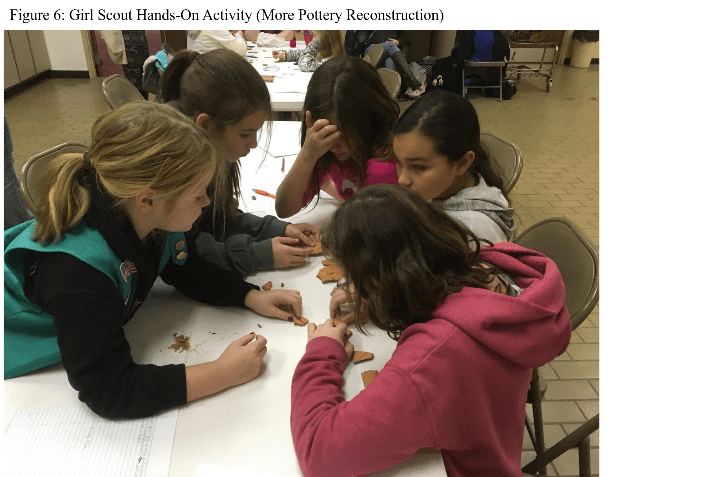
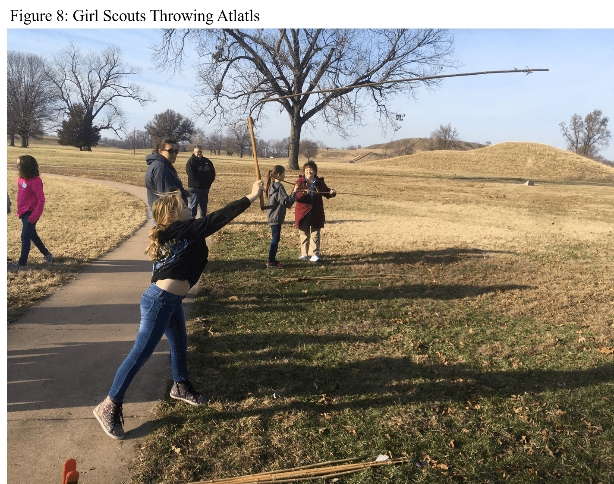
For STEM University, the first half of the program was devoted to an archaeological lecture with several hands-on activities dispersed throughout the session. Lecture topics included defining archaeology, basic excavation methodology, and archaeological laws. Hands-on activities included interpreting aerial photos, creating a stratigraphy snack, and attempting to piece together a broken pottery vessel. The second half of the program was even more hands-on. This portion began with experimental archaeology (Figure 3), in which students threw atlatls and designed an experiment to test atlatl effectiveness. This portion also included a mock excavation (Figure 1), which incorporated soil testing, mapping, note taking, feature/layer identification, and screening.
For both events, I included a before and after examination to evaluate the effectiveness of the program. Most questions were close ended questions, and were meant to enable quantitative analysis. Some questions, however, were broad and open-ended. With the Girl Scout evaluation, I also asked participants to draw what they pictured when they thought of an ‘archaeologist’.
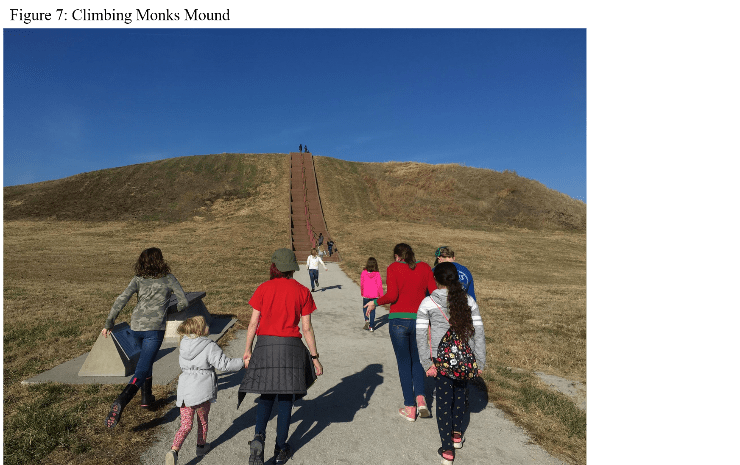
The Girl Scout event was structured slightly different. The morning session was still focused on discussion and activities. However, as I was not constrained by badge requirements, was speaking to a slightly younger audience, and was without a projection system for PowerPoint slides, I focused more on the activities and the group discussion than on the lecture. It included all of the activities offered in the STEM University lecture (Figures 4,5,6), as well as the site mapping simulation. Additionally, I tried to offer more data interpretation activities in order to showcase how STEM is archaeology and to make this even more STEM focused. To align with typical Girl Scout programming, I also decided to include a creative component in which participants were given two ‘artifact assemblages’ of (very random) modern household items and asked to, from the lens of a future archaeologist, create stories about the populations who used these artifacts. The second half of this program included supervised free-time to explore the interpretive center, climbing Monks Mound and touring the site (Figure 7), and throwing atlatls at targets (Figure 8).
Results
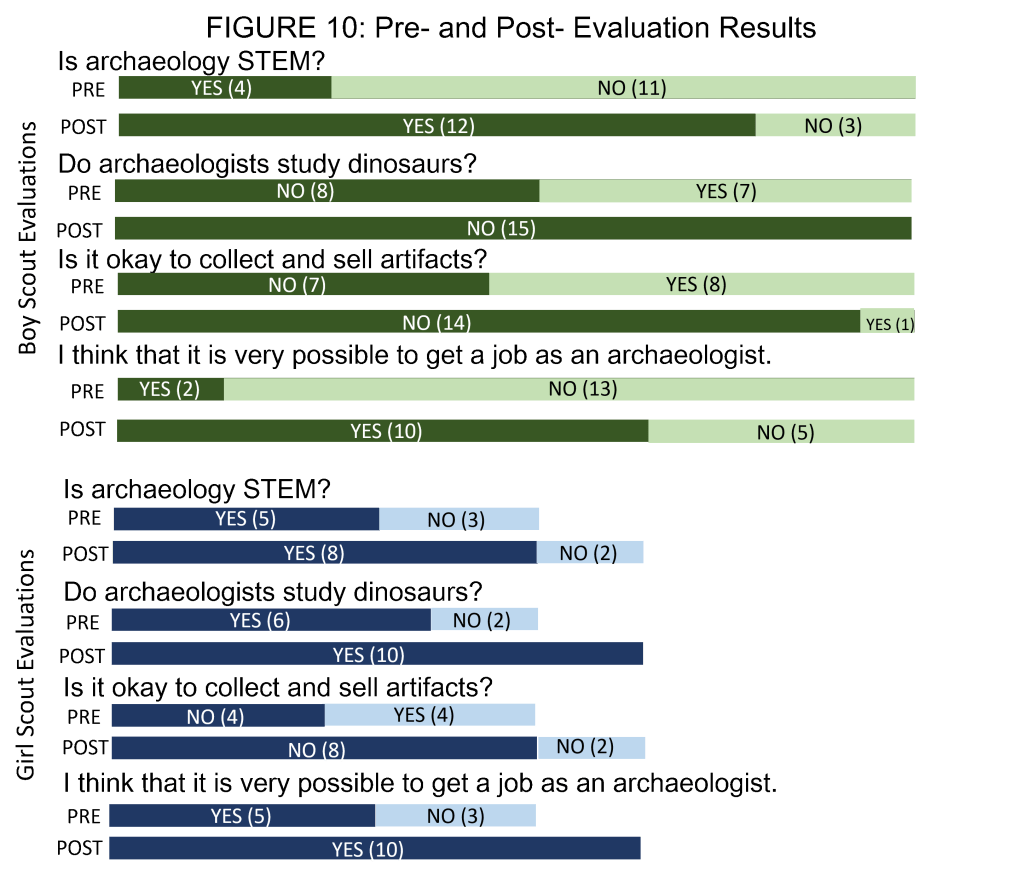
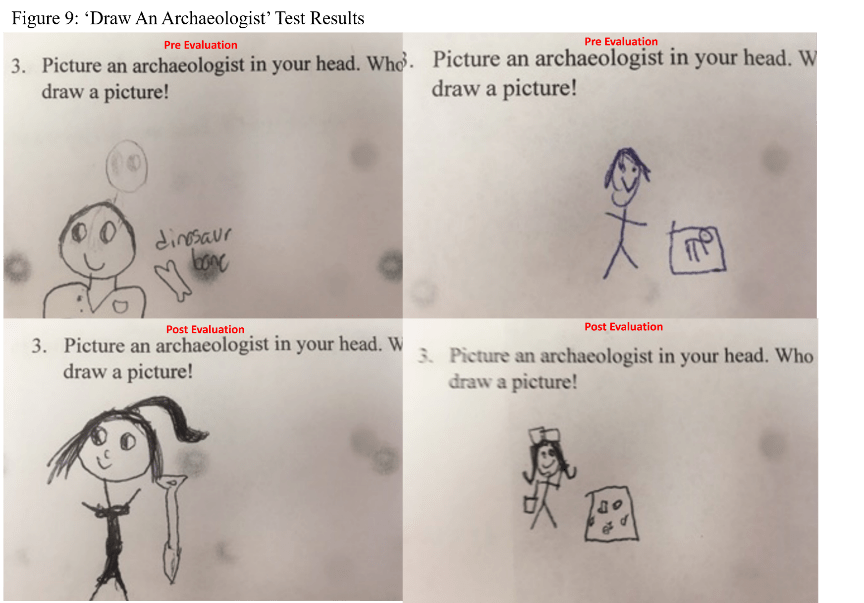
I had 15 Boy Scouts and 10 Girl Scouts attend my events. When asked, “What do archaeologists do?” only ~17% of the pre-test answers, across all events, included anything outside of excavating, while, in the post test, 68% of answers included something other than ‘digging’ or ‘finding artifacts’. When the Girl Scouts were asked to draw their idea of an archaeologist, only two participants drew a clearly feminine figure in the pre-event evaluation. However, in the post-event evaluation, two students had changed their depictions to feminine figures, resulting in a final count of three female archaeologist pictures (Figure 9). Results of the close-ended questions for both groups are detailed in Figure 10. It is important to note that two of the Girl Scout participants arrived late, and were not given the pre-test.
Conclusion
This event was able to positively change participants’ understanding of archaeology, as evidenced by the pre- and post- evaluations. Excitingly, every single participant walked away knowing that archaeology does not involve dinosaurs. Similarly, as demonstrated by the survey results, most participants had a better understanding of what archaeology entails, how archaeology is STEM, and artifact collecting ethics. The most rewarding result, however, was the inclusion of more female archaeologists in the ‘draw an archaeologist’ question. This result stresses the importance of diversity representation in all fields—if children meet and interact with diverse peoples in a particular field, their conception of what an individual within such a field could be might change.
Overall, I learned a lot about the misconceptions surrounding our field, as well as how to confront these misconceptions. I also learned which activities worked best for this age group and will be applying this to future events. In general, I think that Scouting events like these are successful, and would like to see more in the future.
What’s Next?
I am still actively working to improve archaeology offerings for GSOFI. I will be hosting a large, all-ages event in March. This event will include a morning round of stations (various archaeology games, crafts, techniques, etc.) modified for each age group. The second half of the day will be open to older scouts, and will include a larger scale mock excavation. As mentioned in the ‘Background’ section, I am also currently working with Girl Scouts of Southern Illinois to create an archaeology badge program for older Scouts.
as well as a large, all-ages event in March. I am also working with Girl Scouts of Southern Illinois to create an archaeology badge program for older Scouts.
Acknowledgements
I would like to thank the organizers of STEM University, especially Dr. Eric Voss, for allowing me to teach at their wonderful event.
I would like to thank Emily Stanley and Mary Buchanan at the Girl Scouts of Southern Illinois council office for allowing me to offer my own programs, for advertising my events, for providing advice for badge creation, and for working with me to cover the logistics.
Finally, I would like to thank Lori Belknap and Linda Sinco of Cahokia Mounds Interpretive Center for allowing me to use the Interpretive Center’s Education Room, helping me to plan the logistics of my Girl Scout event, providing supplies, and assisting with atlatl lessons. I would also like to thank Kenyatta Simpson for volunteering to help me run the activities for the event.
References
Bevill, Billy
2003 Nursing Exploration Patch for Youth Recruitment. Nursing Education Perspectives
24(5):222—223.
Chrislom, Amelia G., Mark P. Leone, and Brett T. Bentley
2007 Archaeology in the Classroom: Using the Dig Box to Understand the Past. Social
Education 71(5):272—277.
Ellenberger, Katharine and Lorna-Jane Richardson
2018 Reflecting on Evaluation in Public Archaeology. Online Journal in Public Archaeology
8: 65-94.
Florida Public Archaeology Network
2008 Beyond Artifacts: Teaching Archaeology in the Classroom. Florida Public
Archaeology Network, Pensacola, Florida.
Henson, Don
2017 Archaeology and Education. In Key Concepts in Public Archaeology, edited by Gabriel
Moshenka, pp. 60-72. UCL Press: London.
Stewart, Morgan, Katherine Fu, Charlotte Marr de Vries, Laura Jacobson, Jacquelyn Kay Nagel, Kathy Jacobson, and Allison Mae Hughes
2017 Engagement in Practice: A Process for Creating a New “Council’s Own” Junior Girl
Scout Badge in Mechanical Engineering. Paper presented at the Annual Conference and
Exposition for the American Society for Engineering Education in Columbus, Ohio.
 SIUE Public Archaeology